
2025 Annual Survey
Earlier this year, we invited our community, starting with Trinity Members, to respond to what will become our Trinity Annual Survey. Below, you’ll find an analysis of the results.
(Year 1, 2025 — Congregational Snapshot)
Introduction
Earlier this year, we invited our community, starting with Trinity Members, to respond to what will become our Trinity Annual Survey. The goal of this survey is to help us listen to how God is forming our community and to assess how our ministries are supporting growth across our five Core Commitments:
Experience the love of God and life in the Holy Spirit
Invite people into friendship with Jesus
Embody practices and postures that lead to the restoration of our whole person
Make space for meaningful and reconciled relationships
Participate in God’s kingdom work by using our gifts locally and throughout the world
The core of the survey is intended to become an annual, longitudinal tool that will help us observe trends over time and discern where God may be inviting Trinity to grow. It included:
demographic questions
Likert-scale questions (1–5 scale)
open-ended responses
A total of 254 responses were received.
Summary
In short, the results are overall very encouraging. Even our lowest scores are relatively high, just not as high as the others.
The highest scores were related to hope for the future, personal spiritual growth, and Trinity helping people deepen their relationship with God. Relationally, the church is widely experienced as a place of safety, humility, and meaningful connection.
The clearest growth edge is invitation/evangelism. The respondents generally see Trinity as welcoming, but they are less likely to say they’ve invited someone, shared their faith story confidently, or to say they’ve seen someone come to faith through Trinity’s ministry.
Perhaps unsurprisingly, the open-ended comments reinforce that Neighborhood Groups (which come up repeatedly), Sundays, and events/retreats are among the most formative parts of church life. Repeated suggestions included more accessible formation opportunities (especially evenings/weekends), clearer newcomer pathways (which we might need to parse some), and more help translating inspiration into active serving outside the walls of Trinity and invitation of others to join us inside.
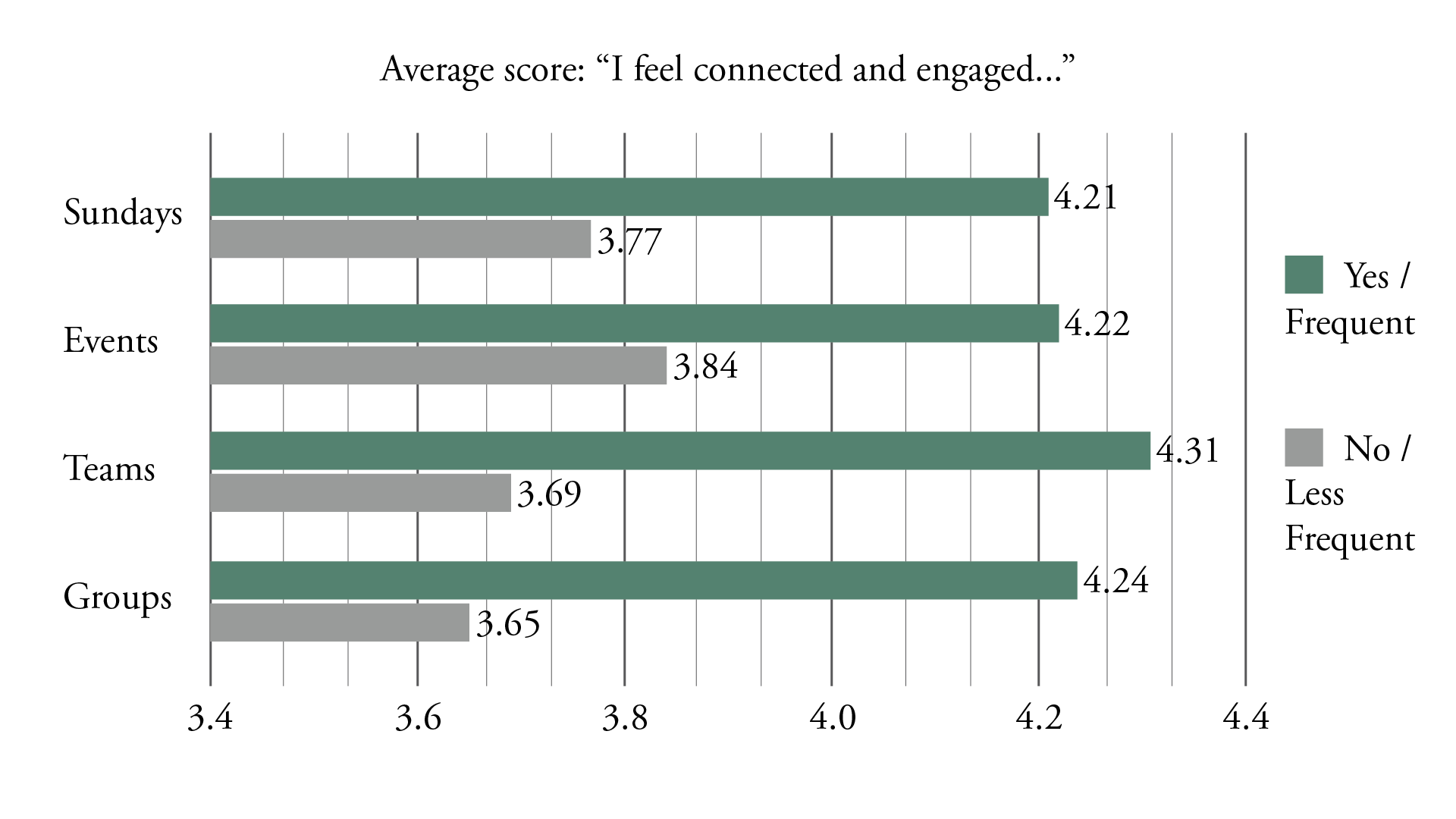
One thing that especially sticks out is the direct correlation that shows respondents who are in groups, serving on teams, attending Sunday services regularly, or attending events/retreats report noticeably higher connectedness (see graph below). While that does not prove causation, it strongly supports the conclusion that those are all indicators of how likely someone is to feel ‘connected’ at Trinity.
Connectedness by Engagement
We tested whether the differences in connectedness between more engaged and less engaged participants were statistically significant. In every case—weekly worship, group involvement, team participation, and event/retreat attendance—the differences were highly significant (p < .001). This means the relationship between engagement and connectedness is very unlikely to be due to chance. In other words, the data suggests that engagement is one of the strongest predictors of whether someone feels connected at Trinity.
Survey Sections Ranked by Average Score
Looking Ahead (last section of survey)
4.47 | 85% agree/strongly agree
CC4: Make Space
4.23 | 80% agree/strongly agree
CC1: Experience
4.23 | 83% agree/strongly agree
CC 3: Embody
4.12 | 78% agree/strongly agree
CC 5: Participate
4.10 | 77% agree/strongly agree
CC2: Invite
3.60 | 57% agree/strongly agree
1. Looking Ahead (last section of survey)
Average score: 4.47 | 85% agree/strongly agree
Questions included:
Overall, I am growing as a joyful disciple of Jesus through the ministry of Trinity. (4.4)
Overall, I feel connected and engaged in the life of our church. (4.1)
I have a hopeful vision for our church’s future. (4.5)
Respondents overwhelmingly believe:
Trinity is helping them grow spiritually
The church is moving in a hopeful and healthy direction
Example comment:
“I am thankful to have found such a sweet community of believers and I look forward to continuing to grow here.”
Interpretation:
This was the strongest section. Respondents overwhelmingly expressed confidence in Trinity’s direction and optimism about the future. That combination—personal discipleship growth and confidence in the future—is very encouraging.
Even though some earlier questions identified areas for growth (particularly around invitation and evangelism), those challenges did not diminish our congregation’s sense of hope about Trinity’s future.
2. Core Commitment 4 – Make Space for meaningful and reconciled relationships
Average score: 4.23 | 80% agree /strongly agree
Questions included:
Feeling known and cared for (4.1)
Meaningful friendships (4.2)
Mutual understanding across differences (4.2)
Feeling safe and accepted (4.3)
Practicing forgiveness and humility (4.4)
Respondents consistently described Trinity as a place where people feel:
known
safe
accepted
supported
Neighborhood Groups were mentioned more than any other specific ministry.
Example comment:
“Neighborhood groups and serving on a team help the church feel small and welcoming.”
Interpretation:
This was one of the clearest strengths in the survey. Respondents strongly affirmed the relational culture of the church.
3. Core Commitment 1 – Experience the love of God and life in the Holy Spirit
Average score: 4.23 | 83% agree / strongly agree
Questions included:
Experiencing God’s presence in worship (4.2)
Sensing the Spirit’s guidance (4.0)
Trinity helping deepen relationship with God (4.5)
Growth in prayer or spiritual awareness (4.1)
Teaching/practices helping people connect with God (4.4)
Strong agreement appeared on statements such as:
Trinity helps deepen personal relationship with God
Teaching and practices connect people with God
Individuals report spiritual growth in the past year
Many respondents mentioned:
prayer practices
liturgy
teaching
spiritual disciplines
Example comment:
“Even after many years here, there are still moments in worship where the Spirit pierces right through.”
Interpretation:
Spiritual formation through worship and teaching is clearly working well. But for the third decimal point, this section was essentially tied with the highest Core Commitment, CC4.
4. Core Commitment 3 – Embody practices and postures that lead to the restoration of our whole person
Average score: 4.12 | 78% agree / strongly agree
Questions included:
Learning to follow Jesus in ways that bring healing (4.3)
Opportunities for personal growth (4.4)
Experiencing grace and support (4.0)
Practicing spiritual disciplines (4.3)
Growth: spiritual (4.2), physical (3.8), intellectual (3.9), relational (4.0), emotional (4.1)
Some respondents noted the importance of:
rule of life practices
retreats
spiritual friendships
Example comment:
“One of my greatest areas of growth this year has been relationally. God has brought reconciliation and healing to several relationships from my past, including some rooted in my childhood. That restoration has been deeply meaningful, reminding me of His grace, faithfulness, and ability to redeem what once felt broken.”
Interpretation:
Respondents report strong growth here, though some (physical, intellectual) tended to score slightly lower than the others.
5. Core Commitment 5 – Participate in God’s kingdom work by using our gifts locally and throughout the world
Average score: 4.10 | 77% agree / strongly agree
Questions included:
Understanding how gifts can be used (4.1)
Connecting faith to justice/mission (3.9)
Serving or volunteering (3.8)
Seeing Trinity make a difference (4.3)
Feeling inspired toward service (4.4)
Respondents generally expressed strong agreement that Trinity:
makes a difference locally and globally
inspires them toward service and compassion
Example comment:
“Creating space of hospitality within our home, sharing our resources (money and meals specifically) with those in challenging seasons, showing up daily for my children, and participating in volunteer opportunities like food packing events.”
Interpretation:
It’s clear that people feel inspired by the church’s mission. There appears to be a slight gap between inspiration and participation.
6. Core Commitment 2 – Invite people into friendship with Jesus
Average score: 3.60 | 57% agree / strongly agree
Questions included:
Sharing faith story (3.8)
Trinity equipping people to invite (3.9)
Inviting someone to church (3.1)
Hospitality toward newcomers (4.1)
Witnessing people come to faith (3.1)
These are the three lowest scores in the whole survey:
inviting someone to church
witnessing people come to faith through Trinity
confidence sharing faith
Example comment:
“It’s hard to know how to invite people to church.”
Interpretation:
This was the lowest-scoring area. It suggests evangelism and personal invitation are less practiced or less visible, even though the congregation values them. This may reflect cultural hesitation around evangelism rather than disagreement with the mission itself. It’s important to note that these are at worst still ‘neutral’ scores and not negative, but there is clearly work to do.
Themes from Open-Ended Responses
Several consistent themes emerged across hundreds of comments.
Strong Community
Many respondents emphasized the importance of:
Neighborhood Groups
Teams
retreats and events
shared spiritual practices
Example:
“Participating in the life of the church beyond Sundays ensures I feel connected through friendships.”
Spiritual Formation
Many respondents shared stories of personal spiritual growth through:
prayer
worship
rule of life practices
Teaching
Example:
“Rule of Life practices and prayer with our neighborhood group have helped me develop rhythms that keep me connected to God.”
Desire for Deeper Scripture Engagement
Multiple responses expressed interest in:
deeper Bible teaching
theological discussion
engaging difficult passages
Example:
“I think we do a great job with emotional health and missions, but Bible study feels lacking.”
Outreach and Mission
Several respondents expressed excitement about Trinity’s partnerships and mission work.
Some suggested expanding opportunities to serve the city.
Example:
“I’d love to see more ways for our church to serve the city together.”
Practical Participation Barriers
A few responses mentioned structural barriers to full engagement at Trinity and serving outside the walls such as:
weeknight scheduling
working parent schedules
youth programming times
There were comments about accessibility of programming for ‘working adults’ and families.
Conclusion
Overall, the survey results reflect a healthy and hopeful community. From both quantitative and qualitative data, the survey suggests Trinity’s strongest areas are:
Relational culture
Spiritual formation
Hope for the future
The clearest growth opportunity is:
Helping people invite others into friendship with Jesus
Respondents widely report that Trinity:
helps them grow spiritually
provides meaningful relationships
inspires participation in God’s mission
At the same time, the survey reveals opportunities to deepen formation, strengthen invitation practices, and expand participation.
This first survey provides a valuable baseline that will allow Trinity to track patterns of growth and discernment in the years ahead.