

For centuries, Christians have meditated on the Stations of the Cross to reflect on the profound mystery of Jesus' sacrifice. In place of walking the Via Dolorosa (Latin for "Sorrowful Way") in Jerusalem, we can journey with Jesus to the cross through fourteen biblical scenes depicting the events leading to Easter morning. These images offer a powerful way to pray and contemplate God's self-giving love.
You can view each of the Stations below—click to enlarge. Biblical texts and reflection prompts accompany each scene to help you engage in what's happening.
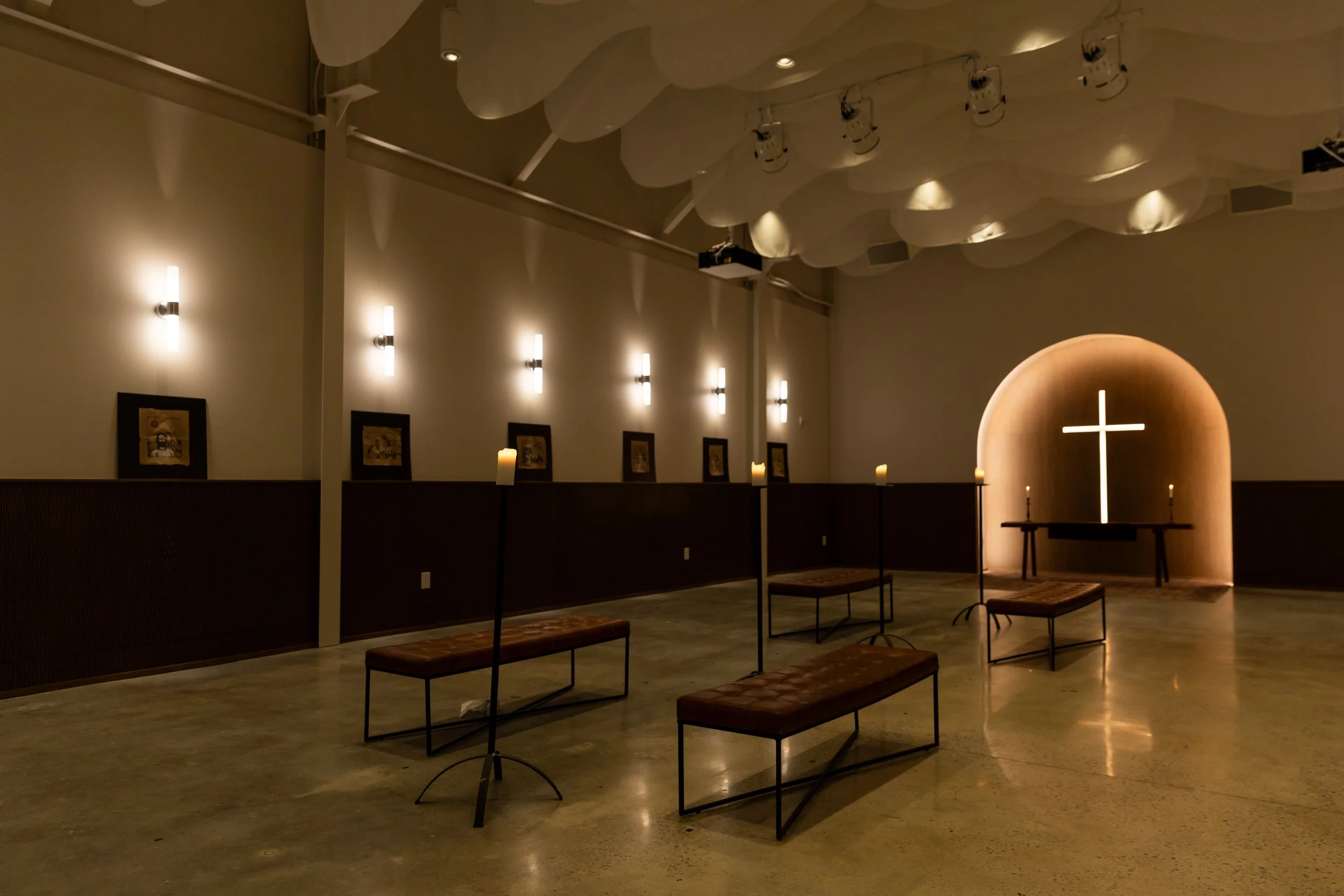
We encourage you to experience this year's In the Raw: Stations of the Cross installation in person, available on Sundays and weekdays starting March 22 through Good Friday, March 3. Hours and details are below.
Scroll down to learn more about this year’s artist, Winfield Bevins, and his work.
Regular Hours
Sundays • Before and after church
Mondays-Thursdays • 9am-4pm
Additional Hours
Friday, 4/3 • 10am through Good Friday Service
Art: Winfield Bevins (2026). In the Raw: The Stations of the Cross, series [pastels and ink on paper bags]. Trinity Anglican Church, Atlanta, GA.
Text following Station 14 is adapted from the Diocese of Erie’s 2023 Stations of the Cross liturgy. Used with permission.
Before you begin.
Let go of any desire to make something happen, or need to see the images in a certain way. Relax and invite the Holy Spirit to take the lead and be your guide. As you prayerfully contemplate each image, the questions below are meant to root you in the events surrounding the crucifixion of Jesus.
Immerse yourself in each scene.
What do you see? Darkness, light, expressions, images within the image etc. How do they relate to one another? How do they change as you move through each station?
Notice what stands out to you.
What detail draws you in or disturbs you? What emotions, memories, or questions does it evoke? Interact with God about what you are experiencing.
You might want to identify with Jesus in the scene.
What is he experiencing? Feeling? How is he responding? What does this stir in you?
How does what you are noticing connect to your life right now?
Ask the Lord what he is saying to you, asking of you, or inviting you into in this. Listen quietly and respond honestly.
When you’re done, please take a moment and let us know about your experience with the Stations.
Share your comments by filling out the form below.
+
“And I, when I am lifted up from the earth,
will draw all people to myself.”
John 12:32
I. Jesus in the Garden of Gethsemane
They went to a place called Gethsemane; and he said to his disciples, ‘Sit here while I pray.’ He took with him Peter and James and John, and began to be distressed and agitated. And he said to them, ‘I am deeply grieved, even to death; remain here, and keep awake.’ And going a little farther, he threw himself on the ground and prayed that, if it were possible, the hour might pass from him. He said, ‘Abba, Father, for you all things are possible; remove this cup from me; yet, not what I want, but what you want.’
+ Mark 14:32-36
Gethsemane means “oil press” or “place of squeezing.” Another gospel account talks of Jesus as being squeezed so hard that he sweats blood (Luke 22:44). What do you imagine Peter, James, and John experiencing as they hear Jesus’ request and see his anguish? What do you notice as Jesus weeps without his friends by his side?
II. Jesus is betrayed by Judas and arrested
Immediately, while he was still speaking, Judas, one of the twelve, arrived; and with him there was a crowd with swords and clubs, from the chief priests, the scribes, and the elders. Now the betrayer had given them a sign, saying, ‘The one I will kiss is the man; arrest him and lead him away under guard.’ So when he came, he went up to him at once and said, ‘Rabbi!’ and kissed him. Then they laid hands on him and arrested him.
+ Mark 14:43-46
Jesus finding his disciples sleeping and Judas’ betrayal, indicates the start of Jesus’ deep isolation and loneliness through his passion journey — cut off from people, cut off from God. What emotions do you feel for Jesus as you hear Judas call him Rabbi, a term used to express his devotion and submission? How do you find yourself responding as you see Judas betray him with a kiss?
Now the chief priests and the whole council were looking for testimony against Jesus to put him to death; but they found none. For many gave false testimony against him, and their testimony did not agree. Some stood up and gave false testimony against him, saying, ‘We heard him say, “I will destroy this temple that is made with hands, and in three days I will build another, not made with hands.”’ But even on this point their testimony did not agree. Then the high priest stood up before them and asked Jesus, ‘Have you no answer? What is it that they testify against you?’ But he was silent and did not answer. Again the high priest asked him, ‘Are you the Messiah, the Son of the Blessed One?’ Jesus said, ‘I am; and “you will see the Son of Man seated at the right hand of the Power”, and “coming with the clouds of heaven.”’ Then the high priest tore his clothes and said, ‘Why do we still need witnesses? You have heard his blasphemy! What is your decision?’ All of them condemned him as deserving death.
+ Mark 14:55-64
III. Jesus is condemned by the Sanhedrin
Notice the faces, the hands, and the expressions in this scene. What do you see? What do you hear? What stirs in you as you see Jesus condemned?
IV. Jesus is denied by Peter
At that moment the cock crowed for the second time. Then Peter remembered that Jesus had said to him, ‘Before the cock crows twice, you will deny me three times.’ And he broke down and wept.
+ Mark 14:72
In Luke’s account of the story, it says “the Lord turned and looked straight at Peter” (22:61). As you look at this image, let the forms and colors take shape before you as you experience Peter’s denial. What must it have been like to realize Jesus knew this would happen?
V. Jesus is judged by Pilate
Pilate asked them, ‘Why, what evil has he done?’ But they shouted all the more, ‘Crucify him!’ So Pilate, wishing to satisfy the crowd, released Barabbas for them; and after flogging Jesus, he handed him over to be crucified.
+ Mark 15:14-15
Reflect on the composition of the two people –– Jesus & Pilate –– comparing and contrasting how they're depicted. What do you make of their postures –– what they're communicating? What is it like to watch Pilate give in to the mob's unjust and angry shouts despite his reservations? What do you see in Jesus as he receives the sentence?
VI. Jesus is scourged and crowned with thorns
And they clothed him in a purple cloak; and after twisting some thorns into a crown, they put it on him. And they began saluting him, ‘Hail, King of the Jews!’ They struck his head with a reed, spat upon him, and knelt down in homage to him.
+ Mark 15:17-19
Stay for a few moments with the violence that must’ve happened in this moment. What is it like for the One you love to endure such contempt and ridicule at the hands of the soldiers?
VII. Jesus takes up his cross
After mocking him, they stripped him of the purple cloak and put his own clothes on him. Then they led him out to crucify him.
+ Mark 15:20
Jesus, having been condemned and beaten, begins his journey to Golgotha, also known as Calvary. Golgotha, the Aramaic name for the hill outside Jerusalem where Jesus was crucified, translates to "place of the skull." This is the seventh of the 14 Stations, what are you feeling and thinking about as we see Jesus carry the cross?
VIII. Jesus is helped by Simon
They compelled a passer-by, who was coming in from the country, to carry his cross; it was Simon of Cyrene...
+ Mark 15:21
What stirs in you upon reflecting on a fragile Jesus who needed help carrying the cross? What do you think this experience was like for Simon?
A great number of the people followed him, and among them were women who were beating their breasts and wailing for him. But Jesus turned to them and said, ‘Daughters of Jerusalem, do not weep for me, but weep for yourselves and for your children. For the days are surely coming when they will say, “Blessed are the barren, and the wombs that never bore, and the breasts that never nursed.” Then they will begin to say to the mountains, “Fall on us”; and to the hills, “Cover us.” For if they do this when the wood is green, what will happen when it is dry?’
+ Luke 23:27-31
IX. Jesus meets the women of Jerusalem
Here, we see Jesus turn from his own pain and suffering and address the pain of these women. Can you sense the heartache and despair in this moment? What do you make of Jesus’ words? Do you hear it as compassion?
X. Jesus is nailed to the cross
And they crucified him, and divided his clothes among them, casting lots to decide what each should take.
+ Mark 15:24
What do you feel in your own body as you stay with this image and hear the soldiers taking his clothes for themselves? What do you feel as you imagine his nail-pierced body?
XI. Jesus promises his kingdom to the repentant thief
One of the criminals who were hanged there kept deriding him and saying, ‘Are you not the Messiah? Save yourself and us!’ But the other rebuked him, saying, ‘Do you not fear God, since you are under the same sentence of condemnation? And we indeed have been condemned justly, for we are getting what we deserve for our deeds, but this man has done nothing wrong.’ Then he said, ‘Jesus, remember me when you come into your kingdom.’ He replied, ‘Truly I tell you, today you will be with me in Paradise.’
+ Luke 23:39-43
Imagine you are the thief who engages Jesus. What is it like to hear Jesus speak those words to you?
XII. Jesus entrusts Mary and John to each other
When Jesus saw his mother and the disciple whom he loved standing beside her, he said to his mother, ‘Woman, here is your son.’ Then he said to the disciple, ‘Here is your mother.’ And from that hour the disciple took her into his own home.
+ John 19:26-27
What does it feel like to know that Jesus took some of his last moments to entrust Mary and John to each other? Imagine you are Mary or John in this scene. What is it like to look up at Jesus, knowing that while he hung there in his last moments, Jesus thought to take care of you?
XIII. Jesus dies on the cross
Jesus cried out with a loud voice, ‘Eloi, Eloi, lema sabachthani?’ which means, ‘My God, my God, why have you forsaken me?’ When some of the bystanders heard it, they said, ‘Listen, he is calling for Elijah.’ And someone ran, filled a sponge with sour wine, put it on a stick, and gave it to him to drink, saying, ‘Wait, let us see whether Elijah will come to take him down.’ Then Jesus gave a loud cry and breathed his last.
+ Mark 15:34-37
“And so he was raised on a cross, and a title was fixed, indicating who it was who was being executed. Painful it is to say, but more terrible not to say... He who suspended the earth is suspended, He who fixed the heavens is fixed, He who fastened all things is fastened to the wood; God is murdered.”
-Melito of Sardis, 180 A.D.
Stay with the awe and horror of this statement and this scene. What do you notice occurring in you as you try to take it in?
XIV. Jesus is laid in the tomb
Then Joseph bought a linen cloth, and taking down the body, wrapped it in the linen cloth, and laid it in a tomb that had been hewn out of the rock. He then rolled a stone against the door of the tomb.
+ Mark 15:46
As you take in this final image, feel the weight of the moment. What must his friends and family have felt? What do you feel?

Our Lord Jesus lies unmoving in the tomb.
The hands that turned water into wine at Cana, now marked by nails, lie still. The feet that walked the hills of Galilee seeking out disciples, now scarred by the stones of Jerusalem’s streets, are motionless. The face of God as one of us, that peered into the eyes and hearts of the forgotten, the unloved, and the suffering, pierced by thorns and stained with blood, sweat, and tears — is lifeless. Jesus, God’s Incarnate Word, once wrapped in swaddling clothes in Bethlehem’s night, is now wrapped in a shroud within the shadow of the cross.
Sorrow fills the air. All seems lost. The world judges Jesus’ mission a seeming failure. As a few men carry him to the grave. As a few women anoint his stilled body. As his mother and friends weep. They wait. We wait.
Yes, we wait in hope for the Easter dawn.
Good Friday was one day
––
Easter is forever.

A note from the artist
“In the Raw” Stations of the Cross series is a set of paintings on recycled brown paper bags that features a raw, rustic, and humbling aesthetic that represents the intersection of faith and everyday life. The brown, fibrous paper bag adds a tactile, earthy quality, and the textured, aged paper highlights the humanity and suffering of Jesus Christ in a humble, accessible way, inviting viewers to experience the passion story in a fresh, contemplative way.

About the artist
Winfield Bevins is an internationally recognized author and artist, and the founding director of Creo Arts, a nonprofit dedicated to bringing beauty, goodness, and truth to the world through the arts. Winfield is also artist-in-residence at Asbury Theological Seminary, where he champions the integration of art, theology, and mission. As an artist, he describes his artwork as “modern iconography” because it explores the intersection where the past and the present meet through sacred art. He believes that we need new forms and expressions of ancient truths to speak to a new generation, that are connected to those who have gone before us, drawing fresh inspiration from the past for our faith for today through art. As an artist, he hopes that his art will invite viewers to slow down and pray to God, who is “ever ancient, ever new.” He and his wife have three daughters and live in Kentucky.
Learn more: winfieldbevins.com
How was your experience?
We’d love to hear from you. Feel free to share anything you’d like about your experience with the Stations of the Cross.